In the digital landscape of modern commerce, information is a dual-edged sword. Data empowers data-driven customer experiences, optimizes operational logistics, and facilitates strategic corporate expansion. However, accumulated, unmanaged data represents a massive, expanding liability. Every byte of redundant, obsolete, or trivial data that an enterprise retains increases its exposure to regulatory enforcement, expensive civil litigation, and catastrophic cyber incidents.
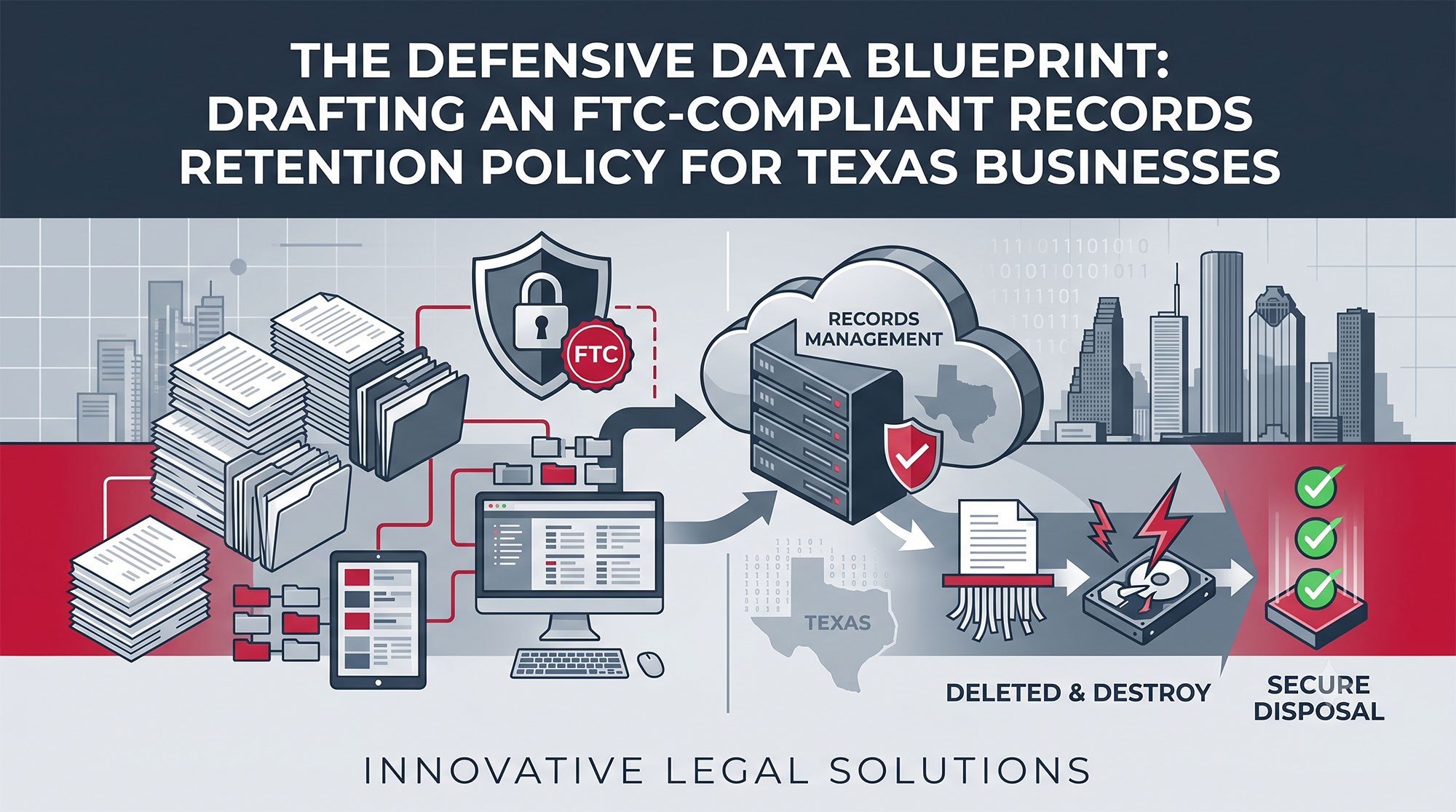
For corporate entities operating in Texas—ranging from the high-tech corridors of Austin to the commercial hubs of Houston—the Federal Trade Commission (FTC) has steadily tightened its scrutiny on corporate data governance. The regulatory message is clear: passive, unstructured collection and indefinite retention of records is no longer just a poor operational habit; it is actively classified as an unfair or deceptive business practice under federal law. To mitigate these risks, the FTC strongly recommends that corporate enterprises design, implement, and strictly enforce a written records retention policy. This corporate blueprint must clearly identify what information must be kept, how long it must be kept, and how to dispose of it securely.
Developing an effective compliance framework requires a calculated, granular understanding of statutory mandates, administrative rules, and the mechanics of modern digital infrastructure. This comprehensive analysis details the structured pillars necessary to build an institutional corporate records retention policy that satisfies the FTC, safeguards intellectual property, and insulates Texas businesses from operational and legal liabilities.
The Regulatory Landscape: Why the FTC Mandates Structured Data Governance
The FTC operates as the primary federal watchdog for consumer privacy and data security. Under Section 5 of the FTC Act, the Commission is empowered to investigate and prosecute “unfair or deceptive acts or practices in or affecting commerce.” In recent years, the FTC has interpreted “unfair practices” to encompass systemic failures in corporate data hygiene. Failing to implement a structured, documented policy for data minimization and secure disposal is routinely cited as a primary failure in administrative enforcement actions.
Furthermore, businesses handling specific categories of consumer data are governed by precise statutory frameworks that carry strict records management components:
- The FTC Safeguards Rule: Broadly applicable to non-banking financial institutions—which the FTC defines expansively to include mortgage brokers, payday lenders, tax preparers, auto dealerships, and certain real estate settlement services—this rule explicitly mandates the secure disposal of customer information. Under its provisions, entities must implement policies that restrict the retention of customer data to only what is necessary for legitimate business purposes.
- The Fair Credit Reporting Act (FCRA) Disposal Rule: Applying to any business or individual who uses consumer reports for commercial purposes, this regulation mandates the proper destruction of consumer report information to mitigate the risk of identity theft. Shredding, burning, or pulverizing physical documents and erasing digital media are strict regulatory expectations.
Texas businesses face an additional layer of state-level oversight. The Texas Deceptive Trade Practices-Consumer Protection Act (DTPA) and the Texas Business and Commerce Code (particularly Chapter 521, the Identity Theft Enforcement and Protection Act) penalize enterprises that fail to implement reasonable procedures to protect personal identifying information (PII). A failure to securely dispose of records containing PII can trigger enforcement actions by the Office of the Texas Attorney General, resulting in civil penalties ranging from $2,000 to $50,000 per violation.
Regulatory Core Principle: The FTC operates under the fundamental doctrine of data minimization. If your commercial enterprise does not possess a verifiable, legally defensible business reason to retain a record, the record should not exist within your production, cloud, or backup environments.
Pillar I: Identifying What Information Must Be Kept
The architecture of a written records retention policy begins with a thorough corporate data inventory. An enterprise cannot manage what it has not mapped. The identification phase requires an organization to categorize every class of record generated, processed, or received across all business units.
Commercial Records Categorization
For the policy to be enforceable and clear, information should be organized into discrete operational buckets, each associated with distinct legal, fiscal, and administrative requirements:
- Corporate Governance and Regulatory Records: This category encompasses articles of incorporation, bylaws, board meeting minutes, shareholder registries, SEC filings, and corporate resolutions. These documents define the legal identity of the enterprise and must be maintained with absolute fidelity.
- Financial, Accounting, and Tax Records: Ledgers, bank statements, invoices, receipts, and state and federal tax returns. The Internal Revenue Service (IRS) imposes strict guidelines on these materials, which are mirrored by the Texas Comptroller of Public Accounts for franchise and sales tax audits.
- Human Resources and Employment Records: Personnel files, payroll registers, Form I-9s, workplace injury logs (OSHA records), benefits documentation, and performance reviews. These files are subject to an intricate matrix of federal oversight via the EEOC, DOL, and the Texas Workforce Commission (TWC).
- Operational and Customer Data: Sales receipts, marketing leads, customer profiles, shipping logs, and proprietary operational workflows. This is the category where the FTC focuses its data privacy enforcement, particularly regarding how consumer PII is stored and partitioned.
- Legal, Contractual, and Litigation-Related Records: Commercial agreements, vendor contracts, non-disclosure agreements, settlement papers, and records subject to an active litigation hold.
Executing the Corporate Data Audit
To populate these categories, legal counsels and operational leaders must conduct inter-departmental audits. This process involves surveying business heads to locate data silos. A modern data audit must extend far beyond the physical filing cabinet and on-premise servers. It must comprehensively index:
- Third-party cloud storage providers (Amazon AWS, Microsoft Azure, Google Cloud).
- Software-as-a-Service (SaaS) platforms (Salesforce, HubSpot, Workday).
- Corporate communication channels (Slack, Microsoft Teams, internal email servers).
- Employee-owned devices utilized under a Bring Your Own Device (BYOD) policy.
Pillar II: Establishing How Long Information Must Be Kept
Once data categories are mapped, the corporate policy must articulate a mathematically precise schedule for retention periods. Setting these timelines is a balancing act: the period must be long enough to satisfy all applicable statutory limitations and tax audit windows, yet short enough to prevent the unnecessary hoarding of hazardous data.
Statutory and Regulatory Guidelines for Retention
The following table outlines standard retention baselines tailored to Texas commercial enterprises based on federal and state regulations:
| Record Category | Standard Retention Period | Primary Governing Authority / Rationale |
| Corporate Bylaws, Minutes, & Charters | Permanent | Texas Business Organizations Code (BOC) |
| Federal and State Tax Returns | 7 Years (Minimum) | IRS Look-back / Texas Comptroller Audit Window |
| Employment Records (Personnel Files) | 7 Years post-termination | EEOC / Title VII / Fair Labor Standards Act (FLSA) |
| Form I-9 (Employment Verification) | 3 Years from hire or 1 year post-termination | U.S. Citizenship and Immigration Services (USCIS) |
| Commercial Contracts & Agreements | 4 Years post-expiration | Texas Civ. Prac. & Rem. Code § 16.051 (Residual SOL) |
| Customer Billing & Transaction PII | 3 Years (Maximum necessary) | FTC Safeguards Rule / Data Minimization Best Practices |
| Workplace Injury Records (OSHA logs) | 5 Years following the marked year | Occupational Safety and Health Administration (OSHA) |
The Legal Intersection: Texas Statutes of Limitations
A critical variable in determining retention lengths for contracts and operational records is the state statute of limitations. In Texas, a breach of contract action must be brought within four years from the date the cause of action accrues (Texas Civil Practice and Remedies Code § 16.004). For personal injury or property damage claims, the limitation period is generally two years (§ 16.003).
A robust records retention policy ensures that all relevant contractual agreements, performance metrics, and communication logs are systematically retained for the full duration of these exposure windows. Purging a contract or project file before the four-year Texas breach-of-contract window closes can leave an enterprise defenseless in sudden commercial litigation.
The Litigation Hold Exception
The policy must contain an absolute, clear override mechanism: the Litigation Hold. Under federal and state rules of civil procedure, as soon as an enterprise reasonably anticipates litigation, a regulatory investigation, or a subpoena, it falls under an unyielding common-law duty to preserve all potentially relevant evidence.
The corporate records retention policy must explicitly state that the moment a Litigation Hold is issued by executive management or corporate counsel, all automated deletion protocols, physical shredding cycles, and server purging routines for the targeted categories of data are instantly suspended. Altering, deleting, or destroying records subject to a litigation hold constitutes spoliation of evidence. In Texas courts, spoliation can result in severe judicial sanctions, including adverse jury instructions, monetary fines, or the striking of the business’s pleadings entirely.
Pillar III: Executing Secure Disposal
The final pillar of the FTC’s recommendation is the core of any defensive data security strategy: secure disposal. Gathering data correctly and scheduling its lifecycle is meaningless if the information is exposed during decommissioning. The FTC has repeatedly penalized firms that permitted sensitive consumer or employee records to be deposited intact into public dumpsters or left on unencrypted, discarded hard drives.
Physical Media Destruction Protocols
For physical records, including paper files, printed medical records, or identity documents, the corporate standard must ensure that the media is rendered entirely unreadable and un-reconstructible. Acceptable corporate methodologies include:
- Contracting with a verified, third-party document destruction vendor certified by the National Association for Information Destruction (NAID). The vendor must provide a formal Certificate of Destruction detailing the date, volume, and method of destruction.
- Implementing industrial-grade cross-cut shredding systems within corporate premises. Strip-cut shredding is insufficient; sophisticated bad actors can reconstruct strip-cut documents using automated scanning software.
Digital Media Decommissioning Protocols
Digital records require distinct technical destruction methods. Deleting a file or formatting a hard drive does not erase the underlying data blocks; it merely removes the operating system’s pointer to that data. Savvy digital forensic tools can extract “deleted” files with ease.
To meet FTC expectations for digital records disposal, Texas enterprises must adopt technical standards aligned with the National Institute of Standards and Technology (NIST) Special Publication 800-88 Revision 1 (Guidelines for Media Sanitization). The policy must mandate one of three NIST-approved frameworks:
- Clear: Sanitizing media by utilizing logical interface commands to overwrite all user-addressable storage locations with non-sensitive data. This is typically executed via secure erase utilities on functional hard drives.
- Purge: Executing physical or logical techniques that render target data recovery impossible using state-of-the-art laboratory techniques. This includes utilizing strong electromagnetic degaussing fields on magnetic media or cryptographic erasure for securely encrypted drives.
- Destroy: Direct physical destruction of the storage media. For solid-state drives (SSDs) and magnetic platters, this involves industrial disintegration, incineration, pulverization, or shredding. Discarded corporate laptops, decommissioned data-center servers, and multi-function office copiers (which contain internal hard drives tracking every scanned document) must undergo this rigorous process before leaving corporate control.
The Copier Trap: Many commercial enterprises overlook lease-end office copiers. These machines store massive volumes of highly sensitive scanned data on internal hard drives. A compliant records retention policy must require that these drives are completely purged or physically destroyed before the machine is returned to the leasing vendor.
Operationalizing the Policy: Training, Auditing, and Enforcement
A beautifully drafted records retention policy sitting unread on a corporate intranet is a major legal liability. In regulatory investigations, a company that possesses a policy but fails to follow it is frequently treated more harshly than an entity with no policy at all, as the failure demonstrates institutional knowledge coupled with operational neglect.
Empowering the Data Governance Committee
To successfully operationalize a records retention program, an enterprise should appoint a cross-functional Data Governance Committee. This committee must bridge the gap between technical operations and legal exposure, and should include:
- Chief Information Officer (CIO) or IT Director: Responsible for executing the digital architecture, implementing automated deletion scripts, and validating cloud bucket lifecycles.
- General Counsel / Corporate Legal Advisory: Responsible for reviewing statutory updates, managing litigation holds, and ensuring compliance with evolving Texas and federal frameworks.
- Chief Risk Officer / Operations Director: Tasked with ensuring operational workflows match policy requirements across geographically dispersed corporate facilities.
Employee Training Frameworks
Human error remains the primary driver of corporate data breaches and accidental spoliation. All newly onboarded employees must undergo mandatory training detailing the records retention policy. Annual refresher courses should be enforced, with specialized training tailored for high-exposure departments such as Human Resources, Accounts Payable, and Customer Support. Employees must clearly understand that corporate communications—including informal chat logs on platforms like Slack or WhatsApp—constitute business records subject to the retention schedule.
Periodic Compliance Audits
The Data Governance Committee must mandate and execute annual compliance audits. Independent auditors should pull random samples across departments to verify that:
- Documents scheduled for destruction have been purged in accordance with timelines.
- Active files are classified and partitioned correctly.
- Certificates of destruction from third-party vendors match corporate disposal logs.
Conclusion: Protecting Your Enterprise through Proactive Governance
In an era characterized by aggressive regulatory enforcement and rising corporate data liabilities, a written records retention policy is an indispensable asset for any commercial enterprise in Texas. By clearly establishing what information must be kept, defining statutory compliance windows, and enforcing rigorous, secure destruction methods, a business protects its operations from devastating cyber breaches, costly regulatory fines, and legal setbacks.
Data minimization is the ultimate corporate shield. Implementing a comprehensive retention strategy streamlines server infrastructure, reduces electronic discovery costs during litigation, and builds a culture of compliance that satisfies the strict standards of the Federal Trade Commission.
Developing this framework requires a thorough blend of technical operational awareness and precise legal counsel. Corporate leaders should consult with experienced legal professionals to customize their retention strategies to match their specific industrial landscape and corporate risk profile. Taking control of corporate data today ensures that your enterprise is built to endure tomorrow.
Legal Disclaimer: The information provided in this article is intended for general informational and educational purposes only and does not constitute formal legal advice. The transmission of this information is not intended to create, and receipt does not constitute, an attorney-client relationship between the reader and Innovative Legal Solutions. Readers should not act upon this information without seeking professional legal counsel tailored to their specific corporate circumstances and jurisdiction.